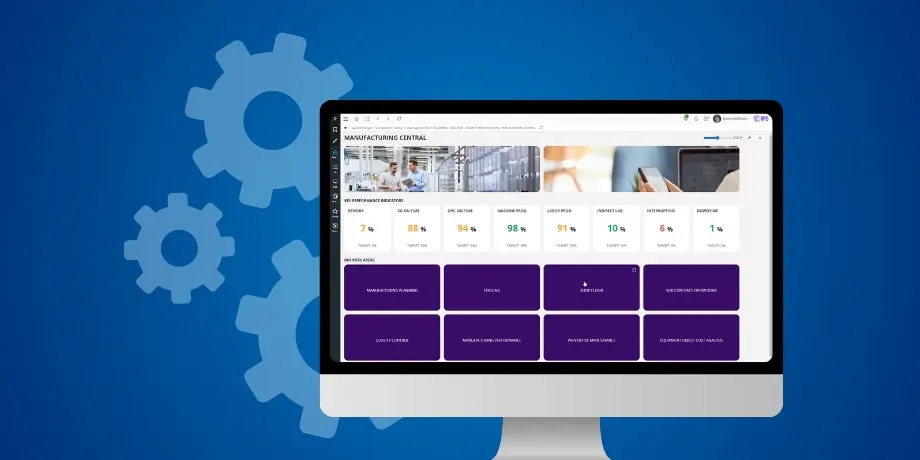
In manufacturing, an ERP system acts as the backbone of the business. At its best, it integrates all the most important business functions into one system. The right solution supports daily production, strengthens growth and makes decision-making easier. For that reason, selecting an ERP system deserves careful consideration. However, there is no single ERP that suits every company. The right choice depends on things such as the company’s manufacturing models, size and business goals.
Without a unified system, information easily gets scattered across separate solutions, which makes production control more difficult and slows down the ability to respond to changes. A modern ERP system typically provides a shared view of production planning, scheduling, inventory management and supply chain management, among other areas. This improves delivery reliability and makes management clearer. The ERP market includes both broad, highly standardized ERP solutions and more industry-specific options with built-in features for the specific needs of manufacturing.
Top ERP solutions for manufacturing companies
IFS Cloud ERP
IFS Cloud is not only regarded by analysts as a leading system for manufacturing, but also one of the few ERP/EAM/FSM systems that customers themselves choose and recognize as the best. In Gartner’s rankings, IFS has been recognized as a leading system and as the only customer-selected option in the Cloud ERP (product-centric), EAM and FSM categories. It has also been recognized in IDC research as a leading manufacturing ERP in the Worldwide SaaS & Cloud-enabled Manufacturing ERP category.
- Best fit for: Mid-sized and large manufacturing companies looking for a scalable solution to support growth, multiple sites and international operations. It works especially well in environments where production is closely linked with areas such as maintenance, projects, supply chain and service.
- Key features: IFS Cloud supports a wide range of manufacturing environments and production models, including project-based manufacturing, make-to-order, engineer-to-order, assemble-to-order, discrete manufacturing, process manufacturing and mixed-mode manufacturing. One of its main strengths is that production, asset management, supply chain management, planning, finance and after-sales services can all be managed on a single platform. This improves visibility across the business and strengthens delivery reliability.
- The system also includes built-in IFS.ai capabilities that use machine learning and predictive analytics. These AI features can create forecasts, simulations and practical recommendations for production and resource planning, while also helping identify production constraints at an early stage.
- Key competitive differentiators: In its research, IDC highlights IFS Cloud’s strong manufacturing focus, ready-made industry processes and broad end-to-end capabilities from production to service. IFS Cloud also stands out by combining ERP, EAM and FSM on one platform. This makes it a strong option especially for engineer-to-order, project-based and asset-intensive manufacturing.
SAP Cloud ERP
- Best fit for: Large manufacturers operating internationally, with multiple sites and a need to standardize operations across the organization while meeting demanding financial, regulatory and reporting requirements.
- Key features: Covers finance, supply chain management, procurement, sales and core manufacturing operations.
- Good to know: Because of its broad scope, the system requires significant investment and a longer implementation time than usual (typically 12–24 months). Support for service, asset management and project-based manufacturing may also require additional configuration or third-party integrations.
Oracle Fusion Cloud ERP
- Best fit for: Large multinational companies looking for strong financial control and standardized processes.
- Key features: In addition to finance, it covers procurement, project management, risk management, performance management and supply chain management, while also supporting integrations with other applications.
- Good to know: Oracle Fusion Cloud ERP works best for companies that are prepared for a centralized operating model. Companies with highly specific needs may need more configuration and more detailed implementation planning.
Infor CloudSuite Industrial
- Best fit for: Small and mid-sized discrete and process manufacturing companies that value an industry-specific solution with ready-made configurations.
- Key features: Supports discrete, process and mixed-mode manufacturing, and covers production planning, inventory management, order management, procurement and finance.
- Good to know: Works best in organizations that are able to invest properly in implementation and training.
Epicor Kinetic
- Best fit for: Mid-sized manufacturing and distribution companies, especially in discrete manufacturing, make-to-order and engineer-to-order environments.
- Key features: Supports finance, supply chain management, production planning, scheduling, inventory management and customer relationship management.
- Good to know: Relevant for companies that focus more on core production processes, straightforward planning and shop floor control than on broad group-level standardization.
Microsoft Dynamics 365 ERP
- Best fit for: Manufacturers seeking close integration with Microsoft 365, Power Platform and Azure.
- Key features: Integrates finance, supply chain management, manufacturing and project operations as part of the wider Microsoft ecosystem. The system supports discrete manufacturing, while features for areas such as process manufacturing are available through third-party extensions.
- Good to know: Implementation and ongoing management require strong technical expertise, and total costs can grow quickly depending on the licensing structure and number of users.
How to choose the right ERP
A good place to start is to assess whether the system’s standard features support the company’s production methods. The better the system supports the operating model through its standard features, the less it needs to be adapted through customizations. It is also important to evaluate the system’s other industry-specific features, usability, integrations with current tools, as well as the company’s growth goals and budget. The number of users also matters, as it directly affects licensing, user access and training needs. For most manufacturing companies, cloud ERP is a sensible choice. It requires lower upfront investment, provides automatic updates and makes remote use easier than on-premise solutions.
Is your company considering the implementation of a new ERP system or planning to modernize its current one? Feel free to contact us, and let’s look at which solution best fits your needs!