Reliable and up-to-date data is the foundation of modern business. As digitalization continues, companies receive a constant flow of data from many sources, and the amount of data in source systems grows quickly. Companies collect data from sales, procurement, production, customer relationships, maintenance and reporting, among other areas. Without clear processes, suitable tools and the right expertise, data easily becomes scattered and no longer supports decision-making, business processes or growth effectively. That’s why companies should invest in improving data management, with Master Data Management tools playing a key role.
Why is master data management important?
In many companies, data exists in several systems at the same time. Customer data may be found in one place, product data in another and supplier data in a third. Several users often update this data at the same time, sometimes even across organizational boundaries. As a result, data becomes duplicated, outdated, incomplete or incorrect. When a company relies on several versions of the same data, analyses and reports lose accuracy and valuable time goes into resolving issues instead of developing the business. Poor data quality also increases costs and reduces revenue.
Master Data Management (MDM) helps companies manage core business data in a consistent and controlled way across different systems. The goal of MDM is to create a single source of truth that the business can rely on. Customer, product and supplier data, along with other key business data, are structured in a consistent way so that the entire organization works from the same data foundation. At the same time, the company creates clear processes and suitable tools for data maintenance.
What kinds of master data management tools are used?
There are many tools on the market for Master Data Management. However, in many organizations the overall solution becomes divided between separate MDM, data quality, integration and governance solutions, which makes maintenance more complex. MDM solutions are at the core of Master Data Management, and they are available for different needs. Gartner, for example, groups MDM solutions into those that support multiple data domains and those focused on customer or product data. A multidomain MDM solution supports several core data domains, while a customer- or product-focused solution focuses on one specific data area in more detail. Still, an MDM solution alone does not solve every problem. Without data quality management and working integrations, errors and gaps can easily remain part of daily operations.
That’s why companies often use complementary tools alongside MDM. These tools solve important parts of the problem, but they do not replace actual Master Data Management on their own. Data quality tools identify errors, missing values, inconsistencies and duplicates, but they do not define the official version of the data. Integration tools move data between systems, but without common rules they also move errors along with it. Governance solutions, in turn, bring visibility to data ownership, rules and traceability, but they usually do not support day-to-day data maintenance.
Aveso’s master data management tool
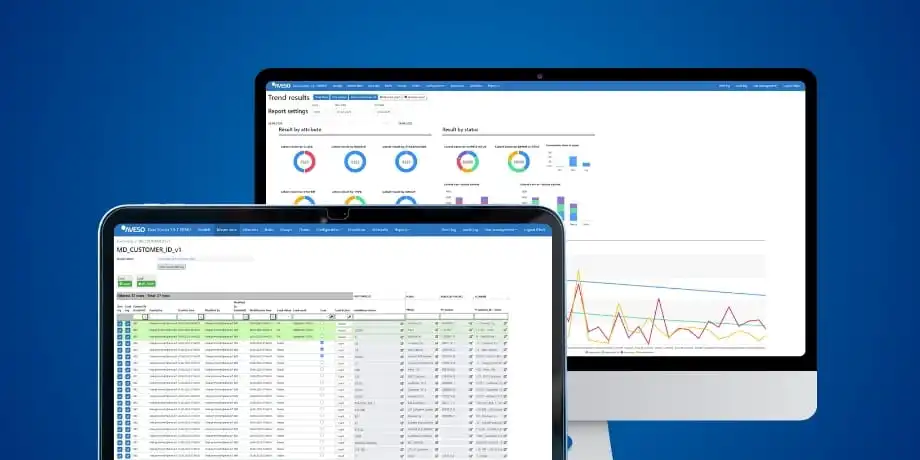
Aveso’s own cloud-based software solution, Aveso Data Studio, brings into one system tasks that many organizations manage with separate solutions. Aveso Data Studio combines Master Data Management and data quality management in one centralized system. It allows companies to define rules, data models and data groups that help collect, enrich, validate and share master data in a controlled way. This makes data processing more consistent and improves the efficiency of data collection processes.
A company can use Aveso Data Studio to centrally manage item, equipment, customer, product and supplier data. Errors in customer data can be detected early, which supports GDPR compliance and smooth invoicing. For item data, incorrect product codes and duplicates can directly affect logistics, inventory balances and deliveries. When item data is well managed, daily processes run more reliably. Equipment data management, in turn, keeps maintenance information up to date, so service activities, spare parts and equipment tracking rely on correct data. Overall, Aveso Data Studio helps companies manage master data centrally, improve data quality and build a transparent, controlled data management process.