In manufacturing, an ERP system acts as the backbone of the business. At its best, it integrates all the most important business functions into one system. The right solution supports daily production, strengthens growth and makes decision-making easier. For that reason, selecting an ERP system is worth careful consideration. However, there is no single ERP that suits every company. The right choice depends on factors such as the company’s manufacturing philosophy, size, production volumes and business goals.
In separate systems, information easily gets scattered, which makes production control more difficult and slows down the ability to respond to changes. A modern ERP system typically gives a shared view of areas such as production planning, scheduling, inventory management and supply chain management. This improves on-time delivery and brings more clarity to management. The ERP market includes both broad, highly standardized ERP solutions and more industry-specific options with built-in features for the needs of manufacturing.
The best ERP system for manufacturing
IFS Cloud ERP
IFS Cloud is one of the fastest-growing ERP systems for manufacturing globally. Its popularity in Finland has also grown over the years. IFS Cloud is a popular choice among Finnish industrial companies whose business is built around configurable products, manufacturing, project-based operations, services and demanding supply chains. IFS Cloud combines supply chain management, manufacturing, project management, maintenance and finance in one system. For Finnish industrial companies, this means better visibility, improved predictability and better responsiveness to changing customer needs and market demands. Its cloud-based system design, modular structure and regular updates make IFS Cloud a modern ERP solution that grows with the business and supports profitable growth.
IFS Cloud is not only regarded by analysts as a leading system for manufacturing but is also one of the few ERP/EAM/FSM systems that customers themselves choose and recognize as the best. In Gartner’s rankings, IFS has been recognized as a leading system and as the only customer-selected option in the Cloud ERP (product-centric), EAM and FSM categories. It has also been recognized in IDC research as a leading manufacturing ERP in the Worldwide SaaS & Cloud-enabled Manufacturing ERP category.
- Best fit for: Mid-sized and large manufacturing companies looking for a scalable solution to support growth, multiple sites and international operations. It works especially well in environments where production is closely linked with financial management, complex supply chains, projects and service operations.
- Key features: IFS Cloud supports a wide range of manufacturing environments and production models, including project-based manufacturing, make-to-order, engineer-to-order, assemble-to-order, discrete manufacturing, process manufacturing and mixed-mode manufacturing. One of its main strengths is that production, asset management, supply chain management, planning, finance and after-sales services can all be managed on a single platform throughout the lifecycle.
- Built-in AI: The system includes built-in IFS.ai capabilities that use machine learning and predictive analytics. These AI features can create forecasts, simulations and practical recommendations, which makes decision-making easier. IFS.ai supports areas such as predictive maintenance, service optimization and the early identification of production and capacity constraints.
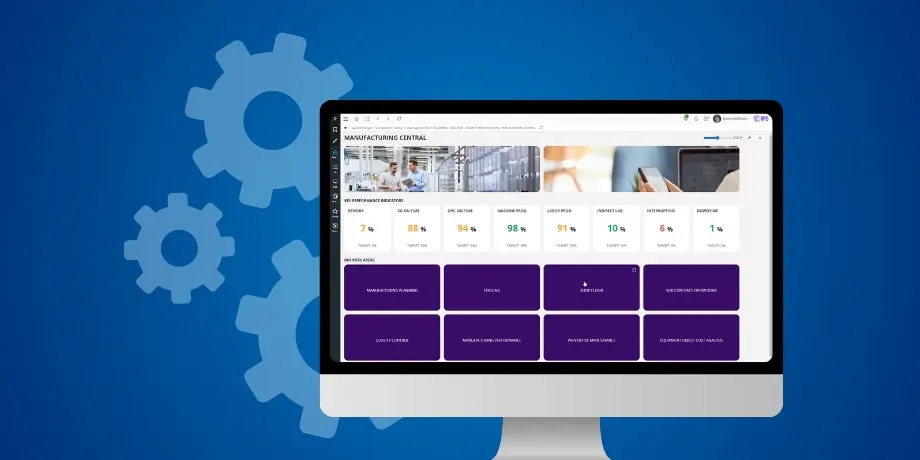
- User experience: The user interface is modern and role-based, which improves user engagement and productivity. A clear interface and mobile support help users in daily work across production, projects and field operations.
- Key competitive differentiators: In its research, IDC highlights IFS Cloud’s strong manufacturing focus, ready-made industry processes and broad end-to-end capabilities from production to service. IFS Cloud also stands out by combining ERP, EAM and FSM on one platform. This makes it a strong option especially for engineer-to-order, project-based and asset-intensive manufacturing.
How to choose the right ERP
A good place to start is to assess whether the system’s standard features support the company’s production methods. The better the system supports the operating model through its standard features, the less configuration and customization it needs. It is also important to evaluate the system’s other industry-specific features, usability, integrations with current tools, as well as the company’s growth plans and budget.
The number of users should also be considered, as it directly affects licensing, user access and training needs. For most manufacturing companies, cloud ERP is a sensible choice because it requires lower upfront investment, provides automatic updates and makes remote use easier than on-premise solutions. It is also worth choosing a local Finnish ERP provider that understands Finnish industry practices, legislation and the business environment. A local partner is easier to reach, supports implementation and long-term development, and can respond quickly to changing business needs.
Is your company considering the implementation of a new ERP system or planning to modernize its current one? Feel free to contact us, and let’s look at which solution best fits your needs.